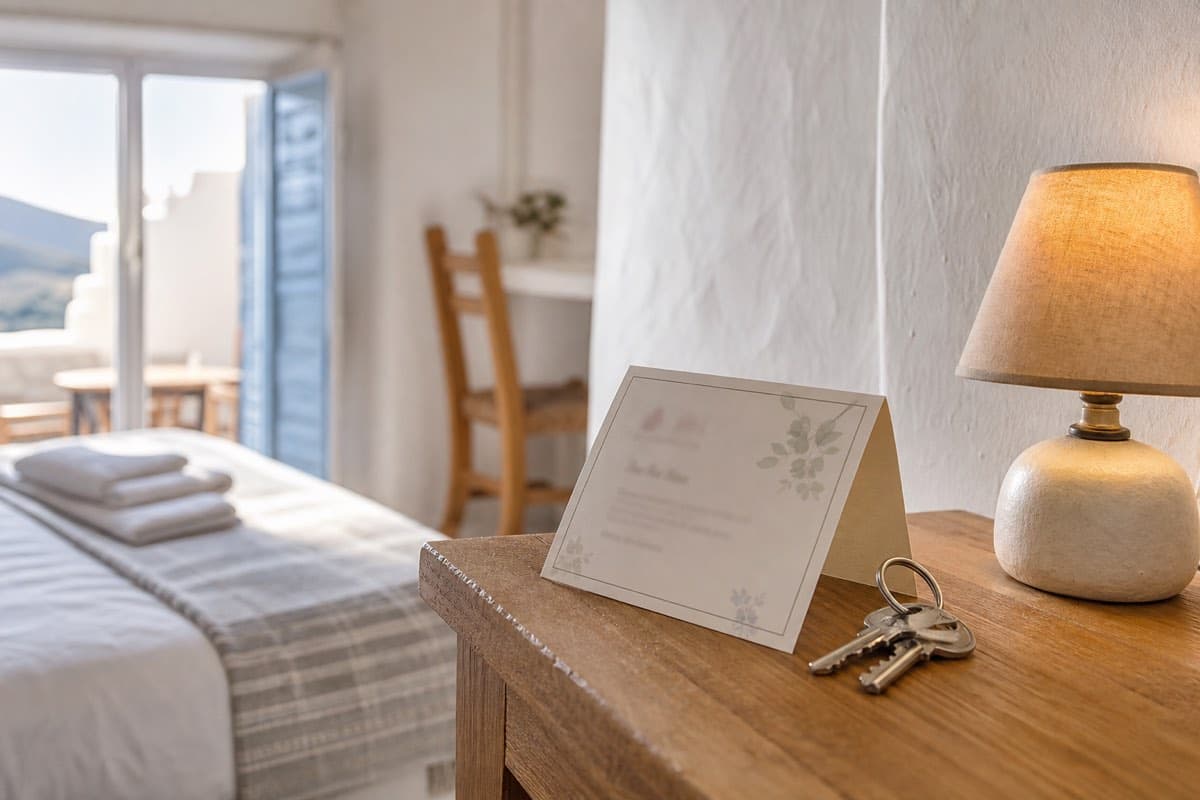
Your guests will read exactly one thing you write. Not the listing description, not the confirmation email. They read whatever sits in front of them when they drop the bags and want three answers: the WiFi password, how the air conditioning works, and where to eat tonight.
That page is the welcome book. A good one answers all three before anyone texts you, and keeps answering all week.
Below is a complete welcome book template, every section already written out in plain host language. Replace anything in [square brackets] with your own details, delete what does not fit, and you are done in about twenty minutes. Nothing to download. Copy it straight from this page.
The free Airbnb welcome book template
Copy everything below into a blank Google Docs or Word file. Where a line already fits your place, keep it as it is.
1. Welcome
Welcome to [Villa Aegeon]. We are [Maria and Nikos] and we live [in the blue house two minutes up the lane]. We are very glad you made it.
Everything you need is in this book. If something is missing, message us any time on WhatsApp at [+30 69X XXX XXX]. No question is too small. There is [cold water in the fridge and fruit from our garden] for you.
2. WiFi
3. Check-in and check-out
4. House rules
5. How things work
6. If you need help
7. Our favorite places
8. Getting around
9. Checkout morning
How to use this template
Paste it into Google Docs or Word, fill in the brackets, then read it out loud once. Anything that sounds stiff, rewrite the way you would say it at the door.
Keep it to two pages, and put your phone number at the top and again at the bottom, because that is the line people hunt for when something goes wrong.
What most hosts get wrong
Too long. Eight pages of rules reads as a warning, not a welcome. If someone has to hunt for the WiFi password, they will just message you instead.
No personal picks. "There are many nice tavernas nearby" helps nobody. "Manolis at the small harbor, ask for the fish of the day" is the line guests remember. You are the only person who can write it.
Stale information. The taverna closed, the taxi driver changed his number, check-out moved to 11:00. A printed book gives the old answer to every guest who walks in, and most of us never reprint it.
Paper or digital
Paper is warm and it works. It has two limits worth knowing before you print fifty copies. It goes out of date the moment anything changes, and it speaks one language, so many of your guests read your best recommendations through a translation app.
A digital guidebook solves both. Change the taxi number once and every guest sees the new one straight away, including those already in the room. The text you write once is read by each guest in their own language. That is what RoomLink does: one QR code on the fridge, your guide in 16 languages, updated from your phone in a minute. See how it works.
Frequently asked questions
How long should an Airbnb welcome book be?
About two pages, or one short screen per section if it is digital. Guests skim while tired, looking for one answer, so long books get closed. If something important feels left out, give it its own heading.
Should I print my welcome book or keep it digital?
Do both if you can. Print one copy for the table, and keep the real version digital so you can fix a phone number in seconds. A confidently wrong printed answer costs you more than no answer at all.
What languages should my welcome book be in?
English plus your own language covers most arrivals, but not all of them. Guests from Germany, France, Italy and the Balkans read your recommendations far more carefully in their own language, and that is usually where the extra boat trip or cooking lesson comes from.
Where should I put the welcome book so guests find it?
In one obvious place, in the first room they walk into. The kitchen table beats a shelf every time. If you use a QR code, put it in exactly one spot, and send the same link in your check-in message so it is on their phone before they arrive.